
1win Bet Types Guide: Structures and Markets Explained
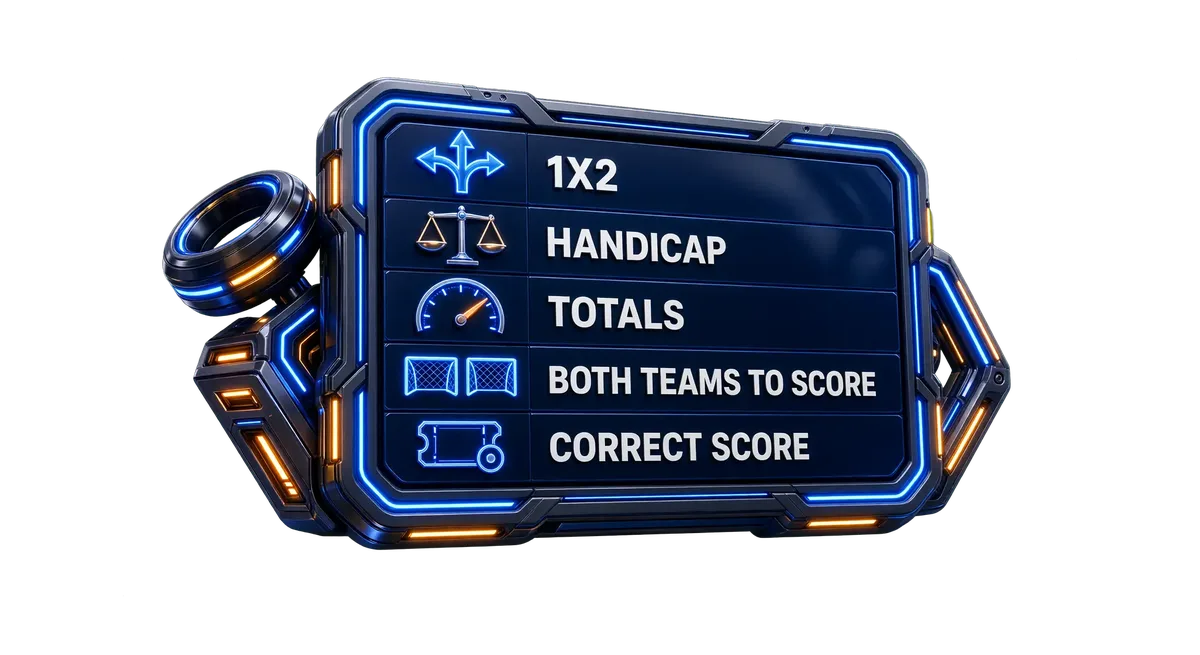
Two different questions get mixed together a lot in betting. How many selections sit on a ticket, and what exactly is being predicted within each selection. This page separates the two clearly: bet structures (Single, Multiple/Accumulator, and the general System bet concept) and market types (1X2, Double Chance, Handicap, Totals, BTTS, Correct Score), each with a plain example and a high-level look at settlement. Odds formats and detailed void or settlement rules aren’t covered in depth here; those live on their own pages, linked further down. For the full current list of sports and markets available to bet on, the sportsbook page is the place to check.
Last reviewed: August 2026.
Key Takeaways
- Bet structure (Single, Multiple, System) is about how selections combine on a ticket; market type (1X2, Handicap, Totals, and so on) is about what’s actually being predicted.
- A Single settles on one outcome alone. A Multiple/Accumulator needs each leg to win, since one losing leg loses the whole ticket.
- 1X2 covers a three-way result, Double Chance covers two of those three outcomes at once, and Handicap applies a scoring adjustment before settlement.
- Totals asks over or under a set line, BTTS asks whether both teams score, and Correct Score asks for the exact final scoreline.
- Exact market availability varies by event. Player and team props, where offered, depend on the specific match, so the app is the place to confirm what’s actually listed for a given fixture.
Bet Structure vs. Market Type: The Core Difference
Bet structure describes how selections are packaged onto a ticket: one selection alone, several combined, or a structured combination of several. It has nothing to do with what’s actually being predicted. Market type is the other half of that: which team wins, whether a total finishes over or under a line, what the exact score ends up being, and so on.
The two combine freely. A Single can be placed on a 1X2 market or on a Totals market just as easily; a Multiple can combine a Handicap selection from one match with a BTTS selection from another. Keeping the two ideas separate makes the rest of this page easier to follow, since each structure below can, in principle, wrap around any of the market types further down.
Bet Structures: Single, Multiple and System
A Single is the simplest structure: one selection, one ticket. If a player places RM50 on a single market selection, the bet settles purely on whether that one selection wins or loses, with no dependency on anything else. It’s the easiest structure to follow because there’s only one outcome to track.
A Multiple, often called an Accumulator, combines several selections into one ticket, where the odds of each leg multiply together into a combined price. If a player combines three selections at RM50 total stake, each single leg needs to win for the accumulator to pay out. The moment one leg loses, the whole ticket loses, even if the other legs won. Each leg’s return is effectively what funds the stake carried into the next leg, and this all-or-nothing settlement is the defining feature of an accumulator.
A System bet is a broader concept used across the betting industry generally: a way of combining multiple selections so that some, but not necessarily all, of the possible combinations need to win for a partial return, rather than requiring each single leg to land like a straight accumulator does. This is described here only as a general concept common across sportsbooks. Specific named system-bet variants aren’t stated as confirmed features of this platform, so checking what’s actually available for combination betting is worth doing directly in the app.
Market Types: 1X2, Double Chance and Handicap
1X2 is a three-way result market: a home win, a draw, or an away win, most relevant in sports where a draw is a realistic outcome, football being the clearest example. A RM50 stake on «home win» settles as a win only if the home side wins outright. A draw or an away win both settle it as a loss, since the selection was specifically the home side.
Double Chance covers two of those three outcomes in a single selection, commonly «home win or draw,» «away win or draw,» or «home win or away win.» Covering more ground generally means a lower potential return compared to picking one of the three outcomes outright on the same match, since the selection is easier to land. A RM50 Double Chance stake on «home win or draw» wins if either outcome happens, and only loses if the away side wins outright.
Handicap applies a virtual scoring adjustment before the result is settled. Asian Handicap concepts generally remove the draw as a possible outcome altogether, sometimes splitting a stake across two lines to soften the effect of a line landing exactly on a whole number. European Handicap concepts generally keep a three-way result (adjusted win, adjusted draw, adjusted loss) after the handicap is applied. Both are described here at a conceptual level; specific handicap lines offered for a given match are set individually per event rather than being fixed values worth listing here.
Market Types: Totals, BTTS, Correct Score and Props
Totals, commonly labeled Over/Under, asks whether a statistic, most often total goals or points scored by both sides combined, finishes over or under a line set for that match. A RM50 stake on «Over 2.5 goals» wins if three or more goals are scored in total during the match, regardless of which side scores them, and loses if two or fewer are scored.
Both Teams to Score (BTTS) is a straightforward yes/no market: does each competing team score at least once during the match. A RM50 «Yes» stake wins if both sides find the net at any point, even in a match that’s otherwise lopsided, and loses if either side fails to score at all.
Correct Score asks for the exact final scoreline rather than just a general direction, which is why it generally carries a higher potential return than simpler markets like 1X2 or Totals. Getting the exact number right on both sides is naturally harder than picking a broad outcome. A RM50 stake on a specific scoreline only wins if the match finishes at exactly that score; any other result, even a very close one, settles as a loss.
Player or team props, where a specific statistic tied to a player or team is the subject of the bet, show up on some events but not others. Whether a given prop market is listed for a specific match depends on the event itself, so this is mentioned here only as a category that exists broadly across sportsbooks, not as a confirmed, consistently available option for each fixture.
Applying These Concepts to Esports: Dota 2 and CS2
The same structures and market types generally carry over to esports betting, adapted to how a given title scores a match. In a best-of-series format common to titles like Dota 2, a 1X2-style «match winner» market becomes a straightforward two-way pick between the two teams, since a draw isn’t a realistic outcome in a series played to a set number of map wins. A Totals-style market, meanwhile, can apply to something like total maps played across a series instead of goals.
In CS2, a similar pattern applies: match-winner and map-handicap markets adapt the same underlying Handicap and 1X2 concepts to rounds or maps rather than goals, and Totals-style markets can apply to total rounds within a map. The exact markets listed for a given Dota 2 or CS2 match still depend on the event itself, the same way they do in traditional sports. For the fuller picture of what’s available for each title specifically, the Dota 2 page and the CS2 page go into more depth than this general guide needs to.
Where to Go Deeper: Odds and Settlement Rules
This page deliberately stays focused on structures and market types rather than covering everything about betting in one place. Two things worth understanding fully sit on their own dedicated pages instead of being repeated here.
How odds numbers themselves work, including the different display formats and how to read a stake into a potential return, is covered in full on the odds page, which goes into the actual math behind converting a price into a return rather than just naming the market types like this page does.
What happens when a match is postponed, a selection becomes void, or a bet needs settling under an unusual circumstance is covered on the bet settlement page, which handles those edge cases in the depth they deserve.
FAQ
What’s the actual difference between a bet structure and a market type?
Structure is about how many selections are on a ticket and how they combine; market type is about what’s being predicted within each selection. A Single on a 1X2 market and a Single on a Totals market share the same structure but different market types.
If one leg of an accumulator loses, does the whole thing lose?
Yes. Each leg needs to win for a Multiple/Accumulator to pay out. A single losing leg settles the entire ticket as a loss, regardless of how the other legs finished.
Is a System bet the same as an Accumulator?
Not quite. An Accumulator generally needs each leg to win. A System bet is a broader concept where some, not necessarily all, combinations can win for a partial return. Specific variants aren’t stated as confirmed features here, so checking what’s actually offered is worth doing in the app directly.
What’s the difference between Asian and European Handicap?
Asian Handicap concepts generally remove the draw as a possible outcome, while European Handicap concepts generally keep a three-way result after the adjustment is applied. Both are conceptual descriptions here rather than a list of specific lines offered on any given match.
Are player props consistently available?
No. Player and team props show up on some events and not others, depending on the match itself. This page mentions them as a category that exists broadly, not as something available for each fixture.
Where can I read about how odds actually convert into a payout?
That’s covered in full detail on the odds page, since it deserves its own dedicated explanation rather than a short mention here.
For context, 1win operates under a Curacao gaming license, a real regulatory framework separate from government approval specific to Malaysia. That’s a platform-wide point rather than anything specific to bet types themselves.